Friday, June 16, 2017

Murder on the Orient Express and Forgiving the Unforgiveable


Despite being an avid mystery reader, a huge Agatha Christie fan, and absolutely adoring her Belgian detective Hercule Poirot for years, I never read Murder on the Orient Express. I never picked it up because I had the who-done-it reveal spoiled, so I believed I already knew the ending and understood the book (THAT is the truly terrible thing about spoilers). 

During my profligate binge watching of crime shows on Netflix I watched an adaptation of this book. Agatha Christie's Poirot: "Murder on the Orient Express" (2010) was fantastic. Starring David Suchet as Poirot, this interpretation of the novel makes use of Poirot's Catholic faith to judge the morality of the crime.

Setting the scene of the episode I watched (spoilers ahead- although I will try to do more justice than the one sentence spoiler that I was given):

Poirot is interrogating a lieutenant in a military setting. The man has been accused of murdering his mistress, and Poirot (while clearing him of that crime), exposes that he has lied about his whereabouts, committed adultery, and accuses him of bringing shame on himself, his rank, and his wife. The man shoots himself in front of the detective. Later, the lieutenant's friend tells Poirot that it is "unjust" the man has had to suffer for this "one" mistake and error in judgment (presumably the adultery and later lying to conceal the affair) as he was a "good man". Poirot questions the use of the word "unjust" and disputes the idea that the man "had no choice" but to commit suicide. "A man like your friend, lieutenant, always has a choice."

The main story starts when Poirot boards the Orient Express in Istanbul going to Calais. The coach is full and there are a number of unique travelers who hail from all over Europe and even America. Poirot is soon approached by a "wealthy American businessman", Mr. Ratchett, who asks the detective to protect him as he believes there are people on the train trying to kill him. He says that he needs to make "penance" before he can be forgiven, but is afraid he will be killed first. Mr. Ratchett comes off as a very seedy character when doing this, neglecting to give any details about why he would be killed and shoving a pile of money at Poirot. The detective refuses.

Later, both Ratchett and Poirot are shown praying in their respective train compartments, Poirot notably holding a rosary. Both ask to be forgiven for what they have done that day and pray for safety that night. The next morning Ratchett is found dead, stabbed 12 times.

During his excellent detective work, Hercule Poirot discovers that Ratchett is a fake name. The man who died was really Lanfranco Cassetti, who kidnapped a little girl in New York five years previously, even collecting a ransom from the grieving parents before murdering her. A tragedy of epic proportions, the girl's mother (pregnant with a younger sibling) went into preterm labor due to stress and died along with the baby. The girl's father and the girl's maid (who was accused of being involved in the crime) committed suicide. Cassetti was caught but used his mob connections to rig the trial and was exonerated. This man was responsible for multiple deaths.

One by one, it is revealed that the other passengers and some train staff have connections to the kidnapped girl or her family (servants to the household, old friends, relations, etc.) and any one could have committed the murder. They have colluded in planting false evidence to make it appear as if someone boarded the train, murdered Cassetti, and then hopped off, but in the end, Poirot deduces that they were all involved in the crime. They drugged Cassetti and each stabbed him in the night, taking justice into their own hands- 12 people for their own jury of 12. 

The episode differs from the original book in this way: while he is himself disgusted at Cassetti and his horrific crime, Poirot insists on turning these people into the authorities because they have become "savages in the street". This dialogue follows:

She's about to claim that they were all "without sin" and justifiably casting stones at the murderer

Poirot: The rule of law, it must be held high! And if it falls, you pick it up and hold it even higher! For all society, all civilized people will have nothing to shelter them if it is destroyed!

Ohlsson [former nurse to murdered girl]: There is a higher justice than the rule of law, monsieur. 

Poirot: Then you let God administer it, not you!

Ohlsson: And when he doesn't, when he creates a hell on earth for those wronged, when priests who are supposed to act in his name forgive what must never be forgiven?

Individually these murderers defend themselves, saying that they were (and ARE) good people who did what was "right". The mastermind of the plan, the dead girl's governess insists that God sanctioned this "execution", but you can see she is distraught and she has not been made whole by avenging these deaths. She says, "when you've been denied justice, you are incomplete. I asked God what to do and He said to do what is right. I thought if I did it would make me complete again..." We can see by her tears and trembling that she is not. 

The episode ends with the police arriving. Poirot and the train company owner hand over the false evidence, effectively letting these 12 people walk free. David Suchet plays this moment spectacularly as he walks away, barely holding back tears of grief and anger. 

And really, it is hard to judge these people. At no point in the episode (and from the research I've now done, the novel) is it implied that Cassetti is innocent. No, he is definitely a child kidnapper and murderer. When he talks about a "penance" he must do before he is forgiven, he refers to returning the ransom money he fled the country with. Cassetti has been blackmailed into returning the money, however, so we can hardly even look kindly upon him for that action. And as for the prayer he says before sleep, even that seems self-serving and not truly repentant. 

See, he looks pretty slimy, right?

Is it possible then, to forgive the unforgivable? 

It reminds me of Psalm 50 (51). David has done the unforgivable, committing adultery and (effectively) killing Uriah, the husband of his mistress Bathsheba so that he can marry her. She has conceived a child that is dying and he knows it is punishment for his sin. 

"...Against Thee, Thee only have I sinned and done this evil in Thy sight, that Though mightest be justified in Thy words and prevail when Thou art judged..."

As someone who grew up reciting this psalm as a regular prayer, I hadn't analyzed it much. So it struck me when the verses above were pointed out by an agnostic friend of mine as troubling. Why has David sinned against God only? He's clearly sinned against Uriah by sending him to certain death in battle, sinned against Bathsheba by committing adultery with her and murdering her husband, and sinned against the child who is ill and lies dying as a punishment for his actions. 

Another way to ask these: How can God forgive these sins when they are against individual people, not God? And subsequently, as Ms. Ohlsson asked Poirot, how can priests act in the name of God to forgive these sins? 

After it is discovered that the murdered man is Lanfranco Cassetti, but before all the evidence is unravelled, Poirot has a long conversation with Ms. Ohlsson, mentioned above. She explains that she is a Protestant missionary who has found Jesus. She tells Poirot that the Catholic faith is false because the concept of "penance" allows priests to forgive the unforgivable. What she does not realize is that the "penance" is not for God's sake, but for ours. 

God stands as judge over us all, over all our own unforgivable sins. Could we forgive the pain and injury someone else has caused us? As much as we choose to let go and seek to be made whole by some other means than vengeance, I believe we can. We can forgive the murderer for the hell on earth we have been made to go through and for repercussions we have suffered. Can we forgive the crime of murder, however? We can forgive what we ourselves have been subject to, but only God can forgive all of the wrongdoing, being the ultimate judge. God will administer that higher justice when we cannot, whether the justice is mercy or punishment. I can forgive the wrongful act done to me, but only God can forgive the act itself. The act itself is a crime, apart from who it hurts. It damages the person who commits it and truly it is an act against God and nature- it is an act against the "higher law". 

Should one feel guilty for the murder of a murderer? Maybe not, but these characters do, and I recon that any "good person" would. The "penance" is not so that God will forgive, but so the good person can repent. Just as with confessing sins to a priest, an act of penitence allows the guilty party to be truly sorry and to know it. Why else would someone tell another person about their unforgivable acts and make reparations? 

Some reparations are not chosen by the sinner, but by God. David understands his son will be killed as his punishment for his crime. When the child dies, he stops fasting and begins to eat again. The servants are puzzled and David tells them, “While the child was alive, I fasted and wept; for I said, ‘Who can tell whether the Lord will be gracious to me, that the child may live?’ But now he is dead; why should I fast? Can I bring him back again? I shall go to him, but he shall not return to me.” David has pleaded with God but is now accepting of the penance made. 

In a way, Ohlsson was right- It was a just punishment for Cassetti to be killed. However, penance is not for God, it is for us. It is so that we can repent and be healed. Unfortunately, Cassetti appears to be taking the idea of penance very legalistically, acting as if returning the ransom money takes care of the matter. Cassetti understands his punishment is to be killed, but he fights against it, still hiring bodyguards and sleeping with a gun. He was not accepting of these reparations, and that is the difficulty of the situation. Cassetti, disgusting child murderer that he is, has been robbed of the opportunity to repent. Isn't that unforgivable?

As for being "good people", it's true. Like the lieutenant at the beginning of the episode, these murderers do seem to be good people. A murderer can be a good person? Yes, sinners are people first. We must think of it the other way around- not that someone who commits an unforgivable sin is no longer one of us, but that any one of us could easily commit an unforgivable sin. 

I'm still trying to figure out why the end of the episode intrigues me so much. According to what I found googling (because I already admitted, I have not read the novel which I'm sure is very good), this internal struggle Poirot has that is depicted in the episode is not present in the novel. Poirot apparently declines to interfere and the train manager decides not to turn any of these people in. 

If it were not for David Suchet's magnificent performance (this episode is really good, you really should watch it), one could easily accuse Poirot of chickening out of turning in the gang, or of condoning vigilante justice. It strikes me that Poirot is doing the very thing that these people could not do- he is leaving the judgment of the crime to God. The law failed the first time by failing to convict Cassetti of his brutal murder, and here the law fails again, the police easily accepting the planted evidence of a mystery assassin. The judgment of God, however is perfect. The story recounted at the link here about Fr. Paisios and God's Judgment illustrates this beautifully. 

There is so much to be said about what is discussed in this episode- sin, forgiveness, penance, justice, "good people"... I could go on for much longer, but I'll wrap it up at this point. I hear there is a new adaptation directed by Kenneth Branagh coming out this year and starring a bunch of A-listers, so I'm really excited to see what they do with the story!
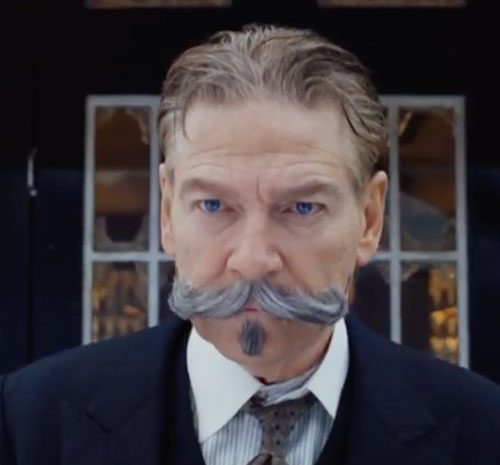
Now that I see the mustache I might be having second thoughts



Thursday, January 17, 2013

Easy Love


Today I’m going to talk about something I know well, because I’ve been groomed to know it well. Today I’m going to talk about love, or rather, what is commonly known as love.

Society is obsessed with love. Movies, television, books, even new philosophies spinning around are all preoccupied with love. Being in love, falling in love, because love is just so great!

“All you need is love,” has become the slogan of...well everywhere, because love is so great, right?

Oh great, now for the bad part.

What is this love? Why would it be all we need? I suppose I first have to distinguish this love that our society promotes from the love found in Orthodox Christianity and the person of Jesus Christ.

Christian love is self-sacrifice. It is asceticism. It is difficult because it is beautiful and, as Plato says, beautiful things are difficult. Christian love is doing stuff we not only have no desire to do, but stuff we really don’t need to do, all because we love the person it is done for.

I don’t HAVE to do this, you know. They can stay like this forever.

Our society does not teach us this. The culture is all about me. I will do what I want with myself and my person. Any mention of self-sacrifice is seen as being against personal freedom and individual expression. Subsequently, society has become selfish and self-focused. All this takes us away from proper Christian love. It is especially a problem in the U.S., where personal liberties are so highly valued.

Help, I'm being oppressed!

Love is too much of an exchange nowadays. It goes along with being unwilling to sacrifice. You benefit me in   this way, I benefit you in that way. Even Stephen. This is actually a very poor way of doing things. When one person can't reciprocate, we get angry because we feel entitled to a fair exchange. Love has become all about entitlement, and therefore it is not True Love, but easy love. 

I call it easy love, because it is easy to have. There is no commitment and sacrifice needed for this love, it is merely feeling. It is easy for me to love when there is nothing required of me. However, that is EXACTLY the reason this love does not last. We learn that nothing is required of us, yet we expect everything in return. I want to be accepted for who I am, just as I am, but someone else? I love you, but I don't love you enough to try to deal with your problems.

Clearly these are YOUR problems, not mine. 

Now, what is "deserved" is behind the entire relationship. "I deserve x", "I don't deserve y". That is absolutely not True Love. Now, I won't say that being treated well isn't endearing, but I am sure any good parent will claim to love their children, however troublesome and messed up they are. I've given my parents a lot of tough stuff to deal with over the years and I know they still love me, though I don't really "deserve" it. True Love should never be about desserts.

True Love is never about desserts :(

God, the Source of Love, loves us unconditionally. It pleases Him when we do better, of course, but that's because He wants the best for us, not because we have to be perfect to earn His love. It's no coincidence He's called Father, either. He has to put up with a heck of a lot more from His children than my parents did.

So, True Love is not easy. Love is not "all you need", because that makes a loving feeling sound like an easy fix. Love is really hard. Action is needed. Service is needed. Here is the difference then. There is easy love, which is the love that society shows us as an ideal, and then there is True Christian love, which is anything but easy.

You might be able to tell by now that I hate doing dishes.

True Love is doing dishes.


Wednesday, January 16, 2013

Am I A Pharisee


Am I a Pharisee
who beats the breast?
For I feel false as hell
but still repent.


Is Every Day Too Often


Is every day too often
To mourn again my sin?
And how to balance out with joy
At having been forgiven?


Something Infinite


Something Infinite is always
present and in motion.
It sustains itself because
there's no beginning just
Infinity, no boundary.
Don't quantify the Infinite
with your finite self.
You can't begin to understand.
When you know this, you are closer,
since you aren't beginning.


Seminars On The Bible


Seminars On The Bible


I took a class that ended a few weeks ago. It was a small discussion based seminar on the Epistles of Saint Paul, though we also read the Acts of the Apostles and the Epistle of Saint James for context.

It was quite funny that we read those "for context", when the entire idea of a free discussion around the texts ignores context. Let me explain. Academia has become extremely reliant on the idea of "Sola Scriptura", whether it is in reading the Bible or any other book. Now, I admit, in some ways this is quite beneficial, especially when it comes to unsubstantiated theories about authors and their works (like what Shakespeare would or wouldn't have kept in his plays). However, ignoring historical context when it comes to the Bible tells you nothing about how the passages should be interpreted.

My class was composed of Christians (Protestant, Catholic, and Orthodox), Jews, and Atheists. Discussion on the Letters became merely many different declarations of our individual opinions. In the opinion sharing, I was a big meanie, since I was so bent on figuring out what St. Paul was trying to say, rather than what we wanted to say about it.

In The Institutes of the Christian Religion, John Calvin wrote: "For as an eye, either dimmed by age or weakened by any other cause, sees nothing distinctly without the aid of glasses, so (such is our imbecility) if Scripture does not direct us in our inquiries after God, we immediately turn vain in our imaginations. Those who now indulge their petulance, and refuse to take warning, will learn, when too late, how much better it had been reverently to regard the secret counsels of God, than to belch forth blasphemies which pollute the
face of heaven

As little as I tend to rely on Calvin, I really like what he says here. However, even in treating Scripture as the glasses to help us see God better, we may still have our vain imaginations when using the lenses. This is exactly what kept happening in my seminar. People read the Bible the way they want to. There is always some mystery, of course. The more you read, the deeper the Scriptures go. However, it is swiftly becoming a taboo to say that there is a wrong way to read them. Not that there is a right way, oh no. In this relativistic culture, everyone can be right, but it is now narrow minded and offensive to call a Biblical interpretation incorrect. Plus, when you believe in "Sola Scriptura", what can you do? Each side can insist they know what a passage "really" means, but in the end they each have an equal amount of biblical authority. They are both simply two individuals who disagree on a passage. That tells us nothing about what a given passage means.

Biblical authority comes with age and history. I find this is the case with many other authorities. Innovation is singular. Authority is lasting. Even evangelicals who have no love of tradition, are subject to Traditional Christianity. Why is gay marriage such a sticking point for evangelical Protestants? It is clearly an innovation. Why is a belief in the Trinity important to them? Because it is consistent with historical Christianity. Not that there is no Scriptural evidence against gay marriage or supporting the Trinity, but when looking merely at the Scriptures, we can still devote ourselves to our own vain imaginations about God. I have seen people who claim to have Biblical support for gay marriage and those who have Biblical support for a non-Trinitarian God. You can always twist something in order to see it the way you want to. What prevents this? A reliance on Tradition. Holy men over hundreds of years have never understood the given passages as supportive of fads of the times. Tradition is the clear context left out of modern Biblical scholarship. 

When Paul tells the Corinthians, "you were washed, you were sanctified, you were justified in the name of the Lord Jesus Christ and by the Spirit of our God," what else do we know it to refer to but the Orthodox service of Baptism and Chrismation? Now if we merely claim that this passage refers to Baptism, someone else may disagree. But if we point to the historical understanding the Church of Christ understood for it, everything becomes clear. 

We must always keep our reliance on Tradition for Biblical interpretation. When we fail to do this, we bow to the equal validity of any interpretation. I've heard some real doozies. Speak to any atheist about their reading of the Scriptures and you'll see what I mean. 

I realize as a proof this is somewhat incomplete, but I'd rather not get too scholastic on this topic right now. 

Friday, March 30, 2012

3 Reasons I Do NOT Want to Become a Female Seminarian


3 Reasons I Do NOT Want to Become a Female Seminarian

I've been putting a lot of thought into going to seminary after I graduate. These are some things I am definitely  not trying to get out of a seminary education and a Masters of Divinity- just to clarify.

3. Women in the Priesthood

Granted, this is not something that has been brought up by any Orthodox person I've mentioned it to, but the fact that I am seeking female ordination is assumed by others (mostly Protestants) when my career plans come up in conversation.

This has lead to a few awkward explanations of how I am not being tricked into submission by the male hierarchy.

WHY doesn't your church let women become priests? How discriminatory!

Ohhh, I see now. Carry on.

The short answer here is, I can feel called to a degree in Pastoral Theology without wanting to serve at the altar. There are quite a few things I could do with this degree, not least of all learn how to put my faith into practice.

That leads me to my next point...

2. Indecision

I have had some problems with choosing a definite career path. I have not been one of those people who has always known what they wanted to do. I have many skill sets and I'm good at a lot of different things, so I've never been eager to specialize. Nevertheless, as I have to keep reminding my mother, this is not a means of escape!

I just devoted my life to Christ. 
No more responsibility!

The thing is, I don't think I HAVE to know exactly what I want to do. Maybe we know immediately what we are called to do, and maybe it is only revealed to us a few steps at a time.This is how I approach going to seminary.I think the discipline would be really good for me, I think I would enjoy the education, and I think I would love all the possible careers that could come out of it.

I could go on to get my PhD and teach, I could go into counseling or hospital chaplaincy, if called I could become a missionary. Heck, I could even use the education to home school ten children, and there is nothing wrong with that.


1. Finding a Husband

There is nothing wrong with thinking ahead to raising children and having a family and there is nothing wrong with wanting to get married.

However, meeting a nice guy is NOT my reason for thinking about going to seminary. Actually, it's been a deterrent. For someone looking to be a priest it's a good bet that there won't be many women around to distract you, but for a woman attending seminary it might be a bit more of a problem.

Keeping this in mind, try not to think I'm a hypocrite when I say I'd still be open to finding a husband there. 

Who could blame me when they all look like this?

This is a good place to emphasize the main reason I'm thinking of going to seminary: trying to be open to God's plan for me.

Being open is hard. Being open means, even after publishing this post and sincerely thinking seminary is the right place to be, accepting that God might have yet an even better plan for my life.

One reason I do want to become a female seminarian is as an act of trust, but I understand that God knows better than I do.


- Alethia


Wednesday, February 15, 2012

My First Onion Dome Article: Priest Faces Criticism Over Churching Decision


Friday, January 6, 2012

Why The Brothers Karamazov is Totally an Orthodox Book


It’s 1 am the night before a paper is due and I’m stuck.

    My paper should be titled something like: “Why Dostoevsky is neither an existentialist nor a relativist” or “Why The Brothers Karamazov is totally an Orthodox book”.  


    At this point, you should probably think to yourself, ‘Oh drat, I haven’t read the Karamazovian masterpiece- Off to the bookstore!’ Or at the very least, ‘Oh drat, I can’t read this post. I don’t want to spoil the book for myself.’ Yes, that means there are spoilers. However to be quite fair, I probably won’t explain them very well and if you’ve read the book you might not think I’m giving anything away. (More excuses? There’s a reason I’ve only been putting up pictures of churches thus far.) Just to be on the safe side, READ IT.


    Why The Brothers Karamazov is Totally an Orthodox Book

    A few reasons:

1. Ivan Fyodorovich Karamazov
    Oh Ivan. This is the guy everyone in my class loves. And why not? They relate to him the best. The reasonable and calm atheist intellectual is a poster boy for any secularly-minded intelligent college student. Dostoevsky knows this, and he’s used Ivan to prove a point. I might also title this reason…

1. “Everything is permitted”

 "It is not freedom when we say to people that everything is permitted. That is slavery." -Elder Paisios

     The idea that everything, and anything, is permitted is dependent on the idea that there is no absolute good, which is where Ivan Karamazov finds himself because he does not believe in God. If there is no God,, and with Him no absolute morality, then nothing matters and everything is permitted. This belief has lead Ivan to invent the Grand Inquisitor, so he can explain the existence of a moral system. The moral system would be kept in place by a number of inquisitors who controlled the idea of what is good through the power of religion (it’s even better that Ivan had to look for an example in Catholic Spain). There is a need for the control of the Grand Inquisitor, he thinks, precisely because there is no good. Without some discipline, the masses might, quite literally, do anything. 

    Ivan begins to run up against his philosophy, however, after the death of his father. If everything is permitted, why should he feel guilty at having left for Moscow? Why should he feel guilty for anything, even at being directly responsible for his father Fyodor’s death? There is absolutely no reason to. This terrifies Ivan, who thrives on his reason, but has developed a guilty conscience.


    When everything is permitted, then truth and good are relative exactly because they do not exist as absolutes. Therefore, Ivan can not continue to live as simply doing what seems right to him. That is to say, existentialism and relativism are very much the same. Life has no meaning, make your own! There is no good, do whatever!


    If it is the case not that “everything is permitted”, but that there is a true right and wrong, the natural conclusion is to look for that absolute morality. To look to God.


    Alexei Karamazov sees the situation clearly when he declares, “God will win!”, and the scenarios for Ivan become clear. “ ‘He will either rise to the light of truth, or…perish in hatred, taking revenge on himself and everyone for having served something he does not believe in.’ ” (p. 655, Pevear and Volokhonsky Translation).


    I think Ivan will rise to the light of truth.


    Well, what does happen?! We’re never told, right? He’s just sick with some sort of brain fever and we never find out what he thinks later!


    It reminds me of Book VI, Chapter 2 when we hear about another devout atheist affected by illness. Markel went from spitefully telling his mother during Lent, “It’s all nonsense, there isn’t any God,” to becoming such a figure of love and joy in his family’s life that his brother Zinovy (later Elder Zosima) directly credits him with influencing his journey to monasticism. 


    I think Ivan will go through such a change as well, because Dostoevsky keeps dropping hints that Ivan wants to believe but has trouble and especially because the last time Ivan is seen in the book, he does something noble and virtuous although he receives no benefit from it and he even expects to come to harm from it. Why would he do that when he has no reason? He doesn’t need to do anything. It’s a huge change for Ivan to be comfortable enough to realize that inconsistency and still act on it anyway. 


    That goes right into…

2.   [Fill in the Blank]   does not prove faith
    There are a bunch of examples of this throughout the book. Best ones are found in  the ‘Odor of Corruption’ chapter.


    This point was and has been pretty hard for me to understand. If there is absolutely no argument that can instill faith, well, then what is the point of arguing, what is the point of fulfilled prophecies, what is the point of miracles?

    “In the realist, faith is not born from miracles, but miracles from faith. Once the realist comes to believe, then, precisely because of his realism, he must also allow for miracles. The Apostle Thomas declared that he would not believe until he saw, and when he saw, he said: ‘My Lord and my God!’ Was it the miracle that made him believe? Most likely not, but he believed first and foremost because he wished to believe, and maybe already fully believed in his secret heart even as he was saying: ‘I will not believe until I see.’” (p. 26)


    If Thomas had truly doubted, would he have ever believed? 


    I don’t think so.


    The fact that miracles are born from faith is good because it is sincere. 


    I’ve fallen for the trap of expecting faith to be provable before. What did that do? It caused me to lose faith in everything. I would beg God to send me a sign, any sign, telling me what to do, proving his existence to me so I wouldn’t despair.


    That isn’t faith. 


    A love needing reasons is not love and neither is a faith needing reasons faith. Unconditional faith is just as necessary as unconditional love and they kind of go hand in hand. 


    Dostoevsky does make a difficult distinction, however, between one who believes because of a proof or miracle and one who accepts a proof or miracle because he believes. They can appear to be the same, as with St Thomas.


    If Thomas had truly doubted, would he have ever believed?


    No.


    Or, yes. But if so, he would have believed in anything.


    Those who believe because of proofs will either never believe in anything or they will believe anything and everything. If I only believe in Christ because of miracles then I will either turn to disbelief when I do not see them or I will soak up the teachings of any false Messiah who comes along as long as he can put on a good show. 


    So I do not believe because of reasons. I believe because God has given me something unconditional and unqualified which I am completely incapable of coming up with on my own. Only an author writing with a belief in God would understand. 


    According to Dostoevsky, the realist knows this.

3. Alyosha, the Realist
    We are told that Alyosha is a realist.


    This surprised me when I read it. Alyosha certainly SEEMS to be an idealist. And it’s true, from that previous explanation about what realism in The Brothers Karamazov is, this realism is not like realism as we normally understand it. 


    This reminds me of a way that I’ve heard icons described: so real they seem fake. Icons are written in a style that does not seem true to life. Don’t the Renaissance church paintings look more ‘realistic’? More three dimensional? The truth is that what is revealed in icons is more real than our reality! Icons are like the incarnation- God in the form of a man, heaven in the form of wood and paint. They are meant to help us become images of Christ. 


    Alyosha Karamazov is an icon of Christ. Having read The Brothers Karamazov, it is quite plain, especially for the Orthodox. Alyosha, like Christ, is called an “early lover of mankind” immediately after he is introduced in the novel. 


    Throughout the novel, this man proves to be kind-hearted and genuine. He is humble and does not hate or judge, but accepts everything, “without the least condemnation, though often with deep sadness” (p. 19). When other characters confide in him, and nearly every character does, he listens understandingly. Over and over again he shocks both characters and readers when he says he is “just the same” and has the same sins. 


    Alyosha is so good at heart that some might think him a poorly written character, just as an icon might seem to be not skillfully painted. Dostoevsky’s “From the Author” admits as much, and he declares that Alyosha is the hero of his story, though many will not understand it. He declares that Alexei Fyodorovich “is by no means a great man”. 


    It is true, he is not great. That fact is what makes him all the more great. We are called to be like Christ in our lives, and most of us will not be great. Not rich, famous, powerful, or exciting. That is not what we are called to be. We are not all called to be missionaries, or monks, or rich philanthropists. Even if we are, what good can we do in Africa, in a monastery, donating large sums to charities, if we can not live as sources of love in the lives of those normally around us? If we can not be a good neighbor to our family members, colleagues, classmates, what good can we do in more exciting venues? A boring, ordinary life lived with Christ is far better than any exciting one lived without. 


    Alyosha is an amazing character because he is not great, he is so real he seems constructed, he is so genuine you could not imagine him lying, but so kind and pure that you struggle to believe him when he admits any wrongdoing. 


    This character is the crowning reason that I could never believe that Dostoevsky is an existentialist and the crowning reason that The Brothers Karamazov is absolutely an Orthodox book.


Wednesday, January 4, 2012

One Orthodox Church for Every Country- Zambia to Zimbabwe


These are all churches that currently hold Orthodox services. If I can't find evidence of a church that holds regular services (house churches count), then the country does not have an Orthodox Church listed. I have included Oriental Orthodox Churches. If you know of a country with an Orthodox Church that I have missed or overlooked, please let me know.


Zambia
 St Mary Coptic Orthodox Church, Lusaka


Zimbabwe


Yay! I finished the Orthodox country alphabet!


One Orthodox Church for Every Country- Yemen


These are all churches that currently hold Orthodox services. If I can't find evidence of a church that holds regular services (house churches count), then the country does not have an Orthodox Church listed. I have included Oriental Orthodox Churches. If you know of a country with an Orthodox Church that I have missed or overlooked, please let me know.


Yemen

Yemen is the only Y country. 
Enjoy!

One Orthodox Church for Every Country- X


XANADU
IS NOT A COUNTRY APPARENTLY. 

SO NONE THAT START WITH X EITHER.


One Orthodox Church for Every Country- W


THERE IS 
NO 
W 
COUNTRY


One Orthodox Church for Every Country- Vanuatu to Vietnam


These are all churches that currently hold Orthodox services. If I can't find evidence of a church that holds regular services (house churches count), then the country does not have an Orthodox Church listed. I have included Oriental Orthodox Churches. If you know of a country with an Orthodox Church that I have missed or overlooked, please let me know.


Vanuatu

 There is not an Orthodox Church on the islands, but here it says that the Orthodox are going to build a chapel for further services. 
Please pray for the Orthodox in Vanuatu!


Venezuela 
 Church of the Sign of the Mother of God, Valencia


Vietnam
Russian Orthodox Parish of Our Lady of Kazan, Vung Tau


One Orthodox Church for Every Country- Uganda to Uzbekistan


These are all churches that currently hold Orthodox services. If I can't find evidence of a church that holds regular services (house churches count), then the country does not have an Orthodox Church listed. I have included Oriental Orthodox Churches. If you know of a country with an Orthodox Church that I have missed or overlooked, please let me know.


Uganda

Orthodox Church of St Nicholas, Namungoona, Kampala


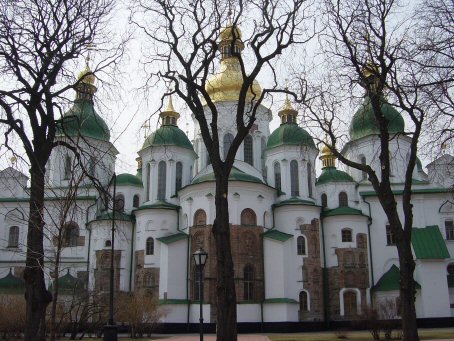
Ukraine
St Sophia Cathedral, Kiev


United Arab Emirates
St Gregorios Orthodox Church, Sharjah 


United Kingdom


United States of America
Russian Orthodox Cathedral of St John the Baptist, Washington D.C.


Uruguay


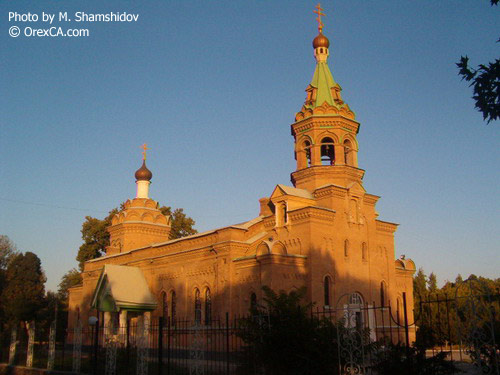
Uzbekistan
St Alexey Cathedral, Samarkand 


Tuesday, December 20, 2011

One Orthodox Church for Every Country- Taiwan to Tuvalu


These are all churches that currently hold Orthodox services. If I can't find evidence of a church that holds regular services (house churches count), then the country does not have an Orthodox Church listed. I have included Oriental Orthodox Churches. If you know of a country with an Orthodox Church that I have missed or overlooked, please let me know.


Taiwan
Holy Trinity Orthodox Church, Taipei


Tajikistan
St Nicholai Orthodox Church, Dushanbe


Tanzania
Church of the Twelve Apostles, Bukoba


Thailand


Togo

I cannot find any evidence of an Orthodox Church in Togo. 
Please pray for an Orthodox Church here!


Tonga

I cannot find any evidence of an Orthodox Church in Tonga. 
Please pray for an Orthodox Church here!


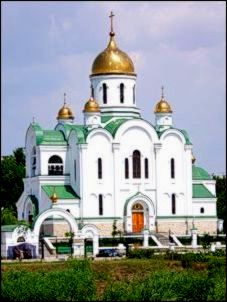
Transnistria 
Church of the Nativity, Tiraspol 


Trinidad and Tobago
Holy Trinity Parish, Beetham Gardens, Port of Spain


Tunisia
Greek Orthodox Church of St George, Tunis


Turkey
Patriarchal Church of St George, Constantinople/Istanbul 


Turkmenistan
Church of St Nicholas the Wonderworker, Ashgabat


Tuvalu

I cannot find any evidence of an Orthodox Church in Tuvalu.
Please pray for an Orthodox Church here!